Residential
Whole-House Repiping in the South Bay
Replacing failing galvanized and pitted copper supply lines in South Bay homes — copper or PEX, permitted, inspected, and drywall put back.
Why plumbing
When a House Has Told You It Needs This
A repipe is not a decision you make from a catalogue. The house tells you, usually in one of three ways.
The first is repeated pinhole leaks in different places. One leak is a repair. A second leak in a different run means the pipe itself has reached the end of its life, and every further repair is money spent opening walls you will open again.
The second is discolored water on first draw in the morning — the rust signature of galvanized steel corroding from the inside.
The third is pressure that has fallen so gradually nobody noticed until a guest mentioned it. Galvanized pipe closes up internally with corrosion over decades; the bore narrows until flow at the furthest fixture is a trickle. That house has not sprung a leak. It has simply run out of pipe.
Why This Is So Common Across the South Bay
Torrance, San Pedro, Harbor City, and the older parts of Redondo Beach were built out heavily between the 1950s and the early 1970s, and that construction was plumbed in galvanized steel. Fifty to seventy years is well past what that material was ever going to give.
The thin-wall copper that succeeded it has its own failure mode — pitting through from the inside, which produces the pinhole leaks that show up as a ceiling stain long after the pipe started failing. Houses that were partially repiped in the 1990s frequently have a mix: a section of newer copper, a section of original galvanized, and a joint between them where dissimilar metals accelerate the corrosion further.
Part of scoping a repipe honestly is opening enough of the wall to find out what is actually in there, rather than assuming from the year the house was built.
Copper or PEX
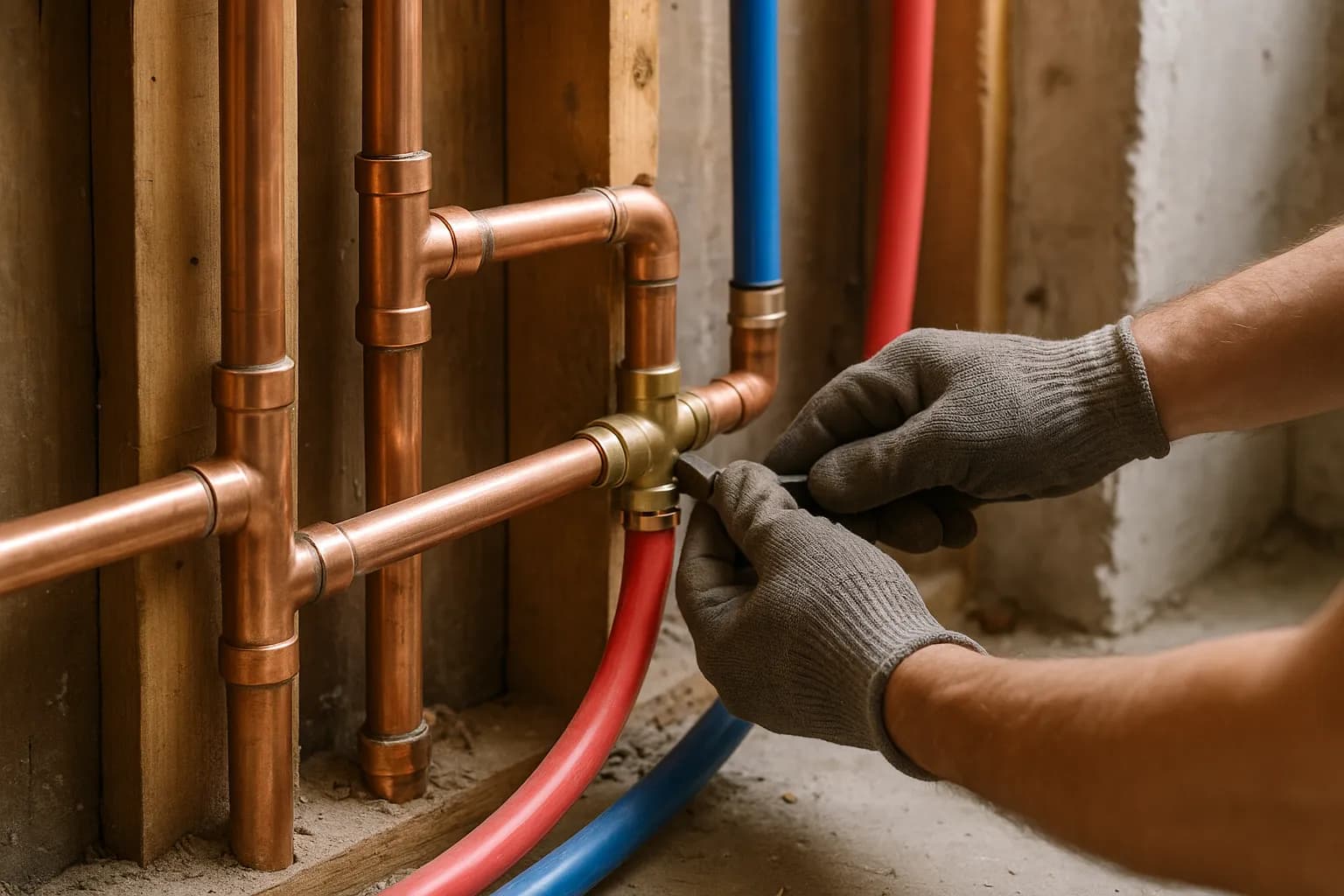
Both are code-legal in California, and both will comfortably outlast the material being removed. The choice is about the specific house.
PEX runs in long continuous lengths with far fewer joints, which matters because joints are where systems fail. It flexes through tight framing, and it is the more practical answer on a slab foundation where routing has to go up and over through the attic. Type L copper is the traditional specification, tolerates high heat, and some owners simply prefer it — including for how it reads to a buyer at resale.
We make a recommendation based on foundation type, routing access, and your horizon on the property. We do not have a house rule, and any contractor who insists there is only one right answer is telling you about their preferred install, not about your building.
What It Costs, Roughly
Nobody can price a repipe properly without walking the house, but you deserve orientation before you start collecting bids.
As a general range for a typical three-bedroom South Bay home, PEX repipes commonly land somewhere around $4,000–$8,000 and copper around $10,000–$20,000. The main driver is fixture count — roughly $650–$1,500 per fixture — followed by access, foundation type, and how much wall has to come out to route the new lines.
What moves a quote more than the pipe material is what the quote leaves out. Three items get excluded routinely: the permit, the drywall patching and texture, and the water main between the meter and the house, which is a separate run and sometimes also at the end of its life. A bid that omits patching is not comparable to one that includes it, and the difference is rarely small. Ours includes the permit and paint-ready patching.
Permits, and Why They Matter at Resale
LA County Code Title 28 requires a permit to replace water piping, and the South Bay cities enforce it. We pull the permit and carry the rough and final inspections.
The rough inspection is the one that counts, because it happens while the lines are still visible. Once drywall closes, nobody can see what was done. A contractor who wants to skip the permit is proposing that the only inspection of the work be the one they perform on themselves.
The practical consequence lands at sale. Unpermitted plumbing work surfaces during escrow with reliable regularity, and resolving it retroactively — sometimes by reopening finished walls — costs considerably more than permitting it would have.
Torrance moved to fully digital plan and permit submittal in January 2026. Larger scopes can draw a plan check rather than an over-the-counter permit, which is a scheduling consideration we build into the timeline rather than discovering mid-job.
Occupied Houses and Occupied Buildings
Most single-family repipes run three to five working days on the pipe work. Water is off during working hours and restored each evening on all but one or two days, and we sequence so a bathroom and the kitchen come back first.
Multifamily is a different exercise. Buildings stay occupied, so work runs riser by riser with written notice to affected units, water-off windows that tenants can plan around, and enough of the building live at any time that nobody goes a day without service. If you manage a South Bay apartment building, see our commercial repipe page for how that sequencing works.
What you get
Everything we deliver.
- 01
Full supply-line replacement
Every hot and cold supply line from the point of entry to every fixture. Partial repipes leave the weakest section in service and are usually false economy.
- 02
Copper or PEX, specified to the house
Type L copper or PEX-A. Which one is right depends on slab vs raised foundation, routing access, and how long you intend to hold the property — not on which is cheaper to install.
- 03
Permit and inspection
We pull the plumbing permit and carry the rough and final inspections. LA County Code Title 28 requires a permit to replace water piping; unpermitted repipes surface during escrow.
- 04
Access, patch, and paint-ready drywall
Walls and ceilings opened where routing requires it, then patched, textured, and left paint-ready. The patching is part of the job, not a separate trade you chase afterwards.
- 05
Pressure test and flush
System pressure-tested before close-up and flushed before handover, so you are not clearing construction debris out of aerators for a month.
How we run it
Scope to sign-off.
01
Inspect and scope
Identify what is actually in the walls — galvanized, thin-wall copper, or a mix from previous partial work. Check static pressure and flow at the furthest fixture. Map routing before quoting.
02
Permit
Plumbing permit pulled with the city or LA County Public Works. Torrance moved to fully digital plan submittal in January 2026; larger scopes can draw a plan check rather than an over-the-counter permit.
03
Rough-in
New lines run and the house left on temporary supply where possible. Rough inspection before anything is closed up — this is the inspection that matters.
04
Close up and finish
Drywall patched, textured, and left paint-ready. Final inspection, pressure test, flush, and a walk-through of every fixture.
Why DECOMA
One license, three disciplines, forty years.
Family-run South Bay general contractor since 1978. We design, build, and manage — under one license — so the team you start with is the team that hands you keys and the team that answers the phone when something needs fixing in year ten.
- Years building
- 48+
- Projects delivered
- 3,000+
- Repeat clients
- 300+
- CSLB Class
- A/B
FAQ
Common questions.
How long does a whole-house repipe take?
Do I need a permit to repipe my house?
What does a whole-house repipe cost?
What is usually left out of a repipe quote?
Copper or PEX — which should I use?
How do I know if I need a repipe rather than a repair?
Why do so many South Bay houses need this?
Do you patch the drywall afterwards?
Service areas
Plumbing across the South Bay.
Born in Harbor City, working across LA County since 1978. Same crew, same license number, same shop at 25941 Frampton Ave, Harbor City.
Talk to a contractor
Tell us about your project.
One business day for a scope, timeline, and budget range. CSLB #375508 A/B.